
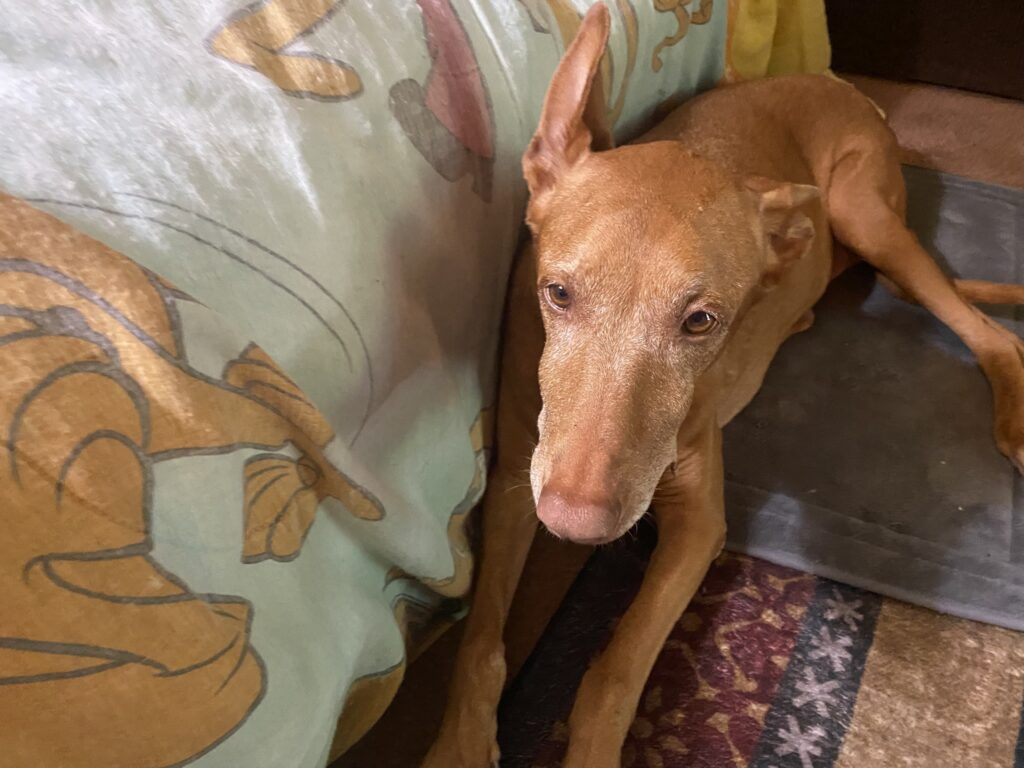



Freya turns 10 this month, which means my formerly unstoppable Pharaoh Hound is officially entering double digits. She would probably object to the word “senior,” especially when there is a chipmunk anywhere within a half-mile radius, but the calendar says otherwise.
And honestly, knowing more about her health feels more important now than it did when she was younger.
That’s one of the reasons I was so interested in trying the Embark Breed & Health Kit. I already knew Freya’s breed, so I wasn’t exactly waiting on the edge of my seat to find out whether my Pharaoh Hound was secretly part Beagle. What interested me far more was everything Embark could potentially tell me about her health.
The test screens for more than 270 genetic health conditions, along with providing information about traits, allergies and sensitivities, ancestry, relatives, and more.
After going through Freya’s results, I actually think Embark makes a lot of sense for senior dogs, including dogs whose breed history you already know.
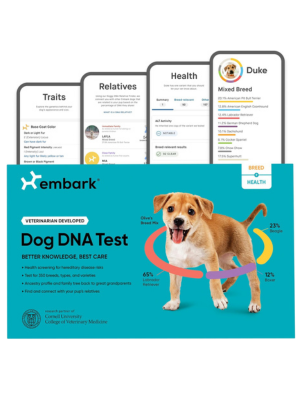
The Embark Breed + Health DNA Test does more than tell you your dog’s breed mix—it screens for 270+ genetic health conditions and offers detailed insights into traits, ancestry, and even potential relatives. Results are clear, thorough, and backed by veterinary research. If you want more than a fun guess at your dog’s background (and actually useful health info), this test is one of the most comprehensive options out there.
LIMITED TIME OFFER
GET $60 OFF BREED + HEALTH TEST
Quick Verdict: Is Embark Worth It for Senior Dogs?
Yes, particularly if you choose the Breed & Health Kit rather than a breed-only DNA test.
For a senior dog, I think the biggest value comes from Embark’s genetic health screening. It obviously can’t tell you everything that may happen as your dog ages (for example, Freya has a heart condition that is not caused by genetics, so it couldn’t tell me that), nor can DNA testing replace regular veterinary care. What it can do is give you another piece of your dog’s health puzzle.
That’s especially useful if you adopted your dog as an adult and know very little about their background.
In Freya’s case, Embark confirmed that she’s 100% Pharaoh Hound and that she was clear for all 273 genetic health risks included in her results. I knew her breed already, but I certainly didn’t know the second part.
There are plenty of fun extras included, too. I found relatives, learned more about her genetic traits, compared her personality to other Pharaoh Hounds, and discovered that Embark knows exactly how suspicious this breed finds pretty much everything.
More on that shortly.
What Is the Embark Breed & Health Kit?
The Embark Breed & Health Kit is an at-home dog DNA test that uses a cheek swab to analyze your dog’s genetic makeup.
While dog DNA tests are probably best known for answering the “what breeds made this dog?” question, Embark goes considerably further.
The Breed & Health Kit includes:
- Breed identification covering 400+ breeds
- Screening for 270+ genetic health conditions
- Genetic trait information
- Allergy risk insights
- Ancestry information
- Relative matching
- Personality insights and activities
- An interactive online dashboard for exploring the results
For a younger dog, all of that can help you learn what you might expect over a lifetime.
For a senior dog, I look at it a little differently. At this point, you already know quite a bit about the dog sleeping next to you. You know their personality, their quirks, what foods agree with them, and which neighborhood squirrel has been personally offending them for the last six years.
What you may not know is what’s hiding in their DNA.
That’s where I think Embark gets particularly interesting.
Embark Breed & Health Kit Pros & Cons for Senior Dogs
| Pros | Cons |
|---|---|
| ✓ Screens for more than 270 genetic health conditions | ✗ Costs more than a basic breed identification test |
| ✓ Useful even if you already know your senior dog’s breed | ✗ Results aren’t immediate |
| ✓ Especially helpful for adopted senior dogs with unknown histories | ✗ A genetic risk doesn’t mean your dog will actually develop the condition |
| ✓ Simple cheek swab you can do at home | ✗ Clear results don’t rule out other health problems |
| ✓ Detailed results are easy to understand | ✗ Some features are more fun than medically useful |
| ✓ Includes allergy, sensitivity, trait, and ancestry insights | ✗ You’ll need an Embark account to access the complete results |
| ✓ Relative matching can fill in some gaps in your dog’s family history |
My own results came back within about two weeks, so the wait wasn’t nearly as bad as I thought it would be. I’ve used other DNA tests for dogs and cats, and they’ve taken MUCH longer (one took over two months).
I also don’t consider the account requirement much of a drawback. The account is included with the test, and I’d rather have Freya’s genetic information sitting behind a login than floating around somewhere anyone can stumble across it.
Why DNA Testing Can Still Be Useful for an Older Dog
I think there’s a tendency to associate DNA testing with puppies and newly adopted dogs.
It makes sense. You bring home a mystery puppy from the shelter, order a DNA test, and discover that the supposed “Lab mix” is actually seven different breeds held together by optimism.
But there’s no expiration date on learning more about your dog.
A genetic health test isn’t a crystal ball. If Embark finds that your dog has an increased genetic risk for something, that doesn’t mean they’re destined to develop it. Likewise, getting an “all clear” doesn’t mean you can stop thinking about their health.
What it does give you is information.
With a senior dog, that information can potentially help you have more informed conversations with your veterinarian. If a genetic risk appears, you can ask what it actually means for your dog based on their age, history, symptoms, physical exams, and other testing.
For rescue dogs, I think the potential value is even greater.
If you adopted a dog at seven, eight, nine, or older, you may know almost nothing about their parents, siblings, breed background, or inherited health risks. Embark can’t reconstruct an entire missing medical history, but it can fill in some blanks that would otherwise stay blank.
Using Embark With My Senior Dog
The testing process itself couldn’t be much easier, which is another plus with an older dog. Inside the kit, you get the cheek swab, sample tube, instructions, and return packaging.
You swab the inside of your dog’s cheek, put the sample into the tube, register the kit, and send it back.
The swabbing itself takes only a minute or two. Whether your dog cooperates is another matter.
Freya treated the entire process with the general suspicion she applies to anything I put near her mouth that isn’t edible. Still, it was over quickly, and there were no needles, vet trips, or complicated sample collections involved.
For seniors who find veterinary visits stressful, I definitely appreciate that the entire collection process happens at home.
Freya’s Breed Results: Exactly What I Expected
There was very little suspense surrounding Freya’s breed results.
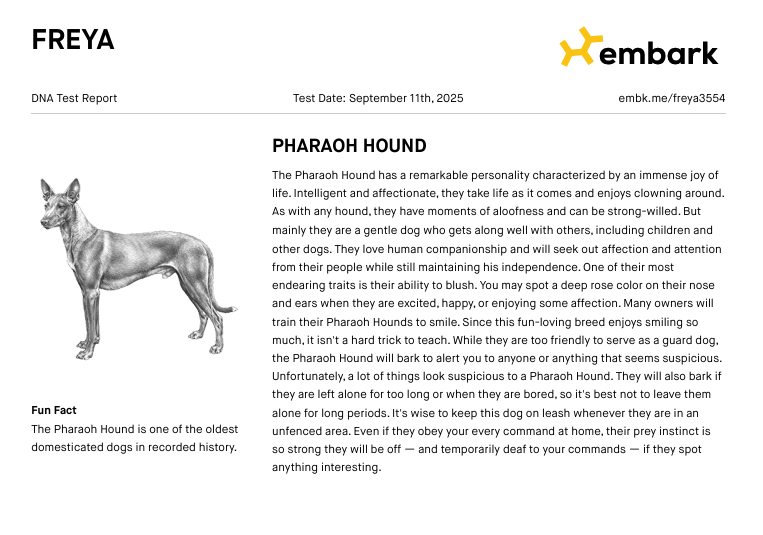
She’s a purebred Pharaoh Hound from a breeder with documented lineage, and Embark confirmed that she’s 100% Pharaoh Hound.
So no secret Beagle after all.
Even though I expected the result, I still liked having the confirmation. For someone with a mixed-breed senior, though, this part could be considerably more revealing.
Knowing your older dog’s breed mix can give you more context about everything from body structure and coat characteristics to certain inherited health risks. It can also finally settle some of those debates you’ve probably been having since you adopted them.
Embark also provides an overview of every breed identified. I was impressed by how well the Pharaoh Hound description fit Freya, particularly when it came to prey drive and barking.
Embark points out that Pharaoh Hounds tend to alert their people to anything they consider suspicious. This is accurate. The problem is that Freya considers quite a lot of things suspicious.
She barks when she’s bored. She barks when she’s hungry. She barks at wildlife. She barks when a cat is doing something that apparently requires my immediate attention. Nearly 10 years into living with her, I can confirm that she takes her self-appointed neighborhood surveillance position very seriously.
The Health Screening Is the Best Part for Senior Dogs
This was easily the most important part of Embark for me. Embark screens for more than 270 genetic health conditions, including conditions associated with particular breeds.
Results are presented in straightforward categories, such as:
- Not at risk
- Carrier
- At risk
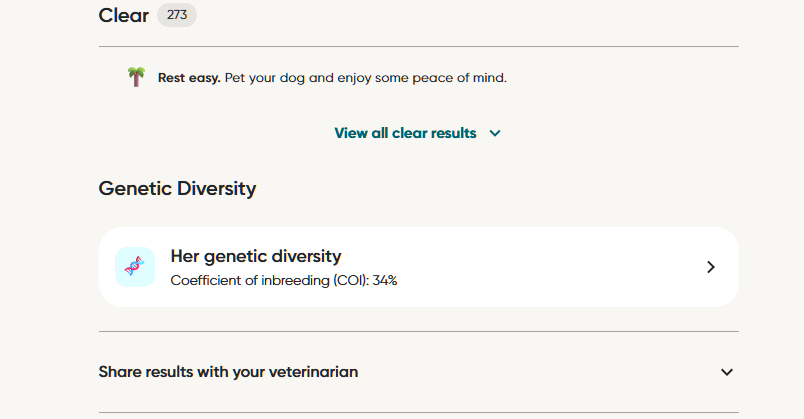
Freya came back clear for all 273 health conditions included in her results. Seeing that was a huge relief.
Does that mean she can’t have health problems because she’s almost 10? Of course not. In fact, Freya was recently diagnosed with a heart condition that isn’t related to her genes.
Even though it can’t predict things like heart disease brought on by aging, it’s still really useful to have a genetic baseline. In fact, with senior dogs who develop heart issues, having that genetic report can give your vet one more piece of information when they’re looking at the bigger picture. If your dog’s DNA results show a known genetic risk associated with heart disease, that’s potentially relevant information to share. If they don’t, that’s useful context too, although it doesn’t rule out inherited factors that aren’t included in the test or heart problems that develop for entirely different reasons.
That’s really how I look at Freya’s Embark results now. They didn’t predict her heart condition, and I wouldn’t expect them to. But they did tell me that she wasn’t considered genetically at risk for any of the heart-related conditions Embark screened her for. Now that we’re dealing with an actual heart issue, I’m glad that’s one more piece of her health history that I already have.
For me, that’s where DNA testing fits into senior dog care. It’s not a replacement for bloodwork, imaging, regular exams, or any of the other decidedly less fun things that start appearing on the senior-dog checklist. It’s simply another source of information, and when you’re trying to keep an older dog healthy, I’ll take all the useful information I can get.
What If Embark Finds a Genetic Health Risk?
This is worth discussing because getting an “at risk” result for a senior dog could understandably be unsettling. I know when I got the results from my own DNA test I was freaked out when it told me that I was at a higher risk for DVTs (deep vein thrombosis, aka blood clots).
The important thing to remember is that genetic predisposition isn’t the same thing as a diagnosis.
Some conditions require particular gene combinations to develop. Others are influenced by environmental factors or additional genes. The significance of a result can also depend on your dog’s breed and individual medical history.
In other words, don’t see a flagged result and immediately assume the worst.
Instead, I’d save the information and discuss it with your veterinarian. They can help put the result into context and determine whether it warrants additional monitoring or testing.
That’s really how I view Embark’s health information overall: it’s something to add to your dog’s health file, not something that replaces it.
Allergy Risk and Sensitivity Insights
Embark also includes genetic insights related to environmental, food, and contact allergy risks.
This isn’t an allergy diagnostic test, and I wouldn’t use it to diagnose a food allergy or decide that a dog suddenly can’t eat an ingredient they’ve been eating happily for years.
Still, it’s interesting context.
Freya came back below average for environmental, food, and contact allergy risks. Her environmental risk was the highest of the three at 4.8%.
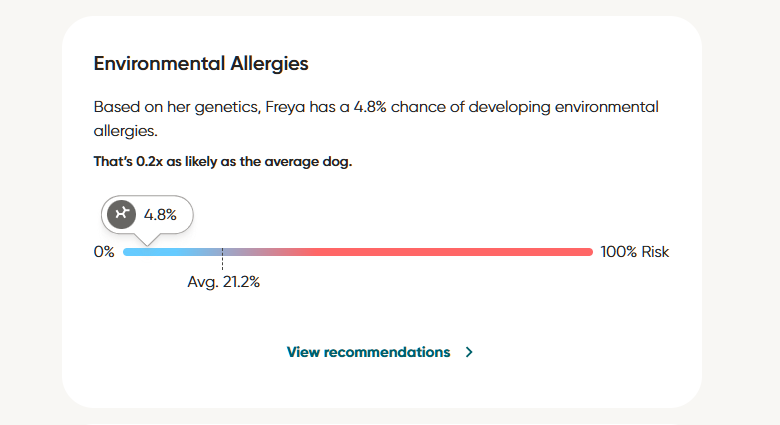
That actually fits her pretty well. She does have some mild seasonal allergy issues, but nothing particularly dramatic.
Her one confirmed allergy is to cicada killer wasp stings (and ONLY that specific wasp), which thankfully isn’t the sort of thing she encounters regularly. In fact, unless she lives into her 20s (which would be so amazing, but I know it’s an unrealistic dream), she’ll never encounter them again.
For a senior dog who has dealt with recurring skin or digestive problems over the years, this section may give you another avenue to discuss with your vet. Just keep its limitations in perspective.
Traits Are Mostly Fun, But Still Interesting
By the time your dog reaches senior status, you probably don’t need a DNA test to tell you what they look like.
I’ve had nearly a decade to notice that Freya has long legs.
Still, I enjoyed going through Embark’s trait section.
It looks at genetic markers associated with things like:
- Coat characteristics
- Shedding
- Body size
- Eye color
- Physical structure
- Certain behavioral tendencies
Most of Freya’s results simply confirmed what I already knew.
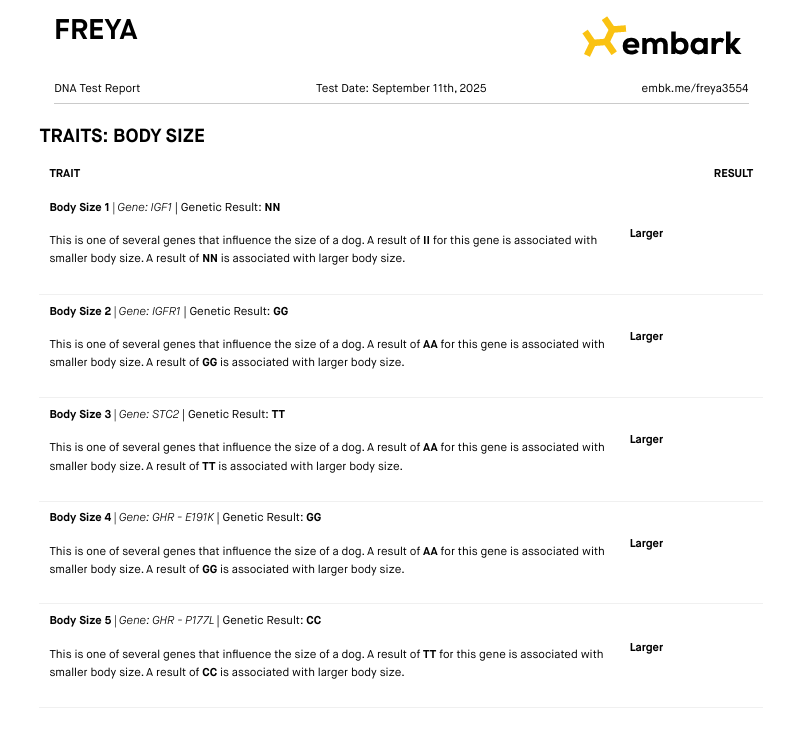
One thing did surprise me, though. Her genetics suggest she’s predisposed to a larger body size than the average Pharaoh Hound.
I found that particularly interesting because I’d seen a similar result on another DNA test.
With mixed-breed senior dogs, I think this section becomes even more fun because it can help explain some of those physical characteristics that never seemed to match the breed you thought they were.
Embark’s Personality Test Gets Surprisingly Specific
Embark has also added a personality assessment that compares your answers about your dog with other dogs of the same breed.
Obviously, this isn’t why I’d buy a Breed & Health Kit for a senior dog. It is, however, entertaining.
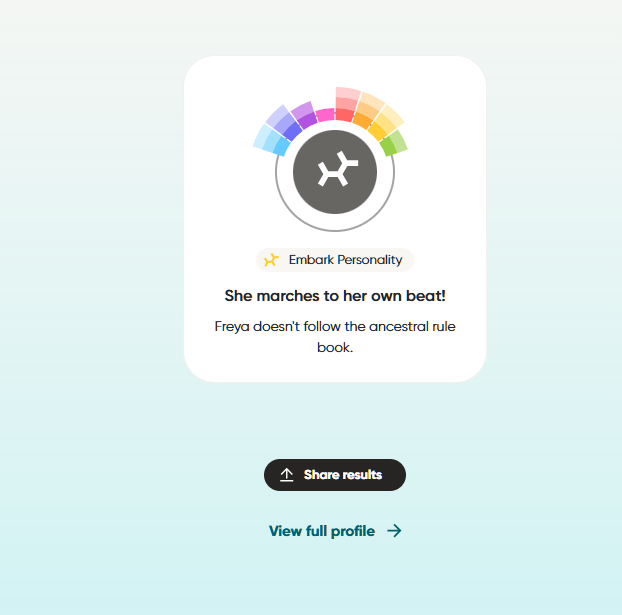
Freya’s results said that she “marches to her own beat,” which may be the least surprising result Embark gave me.
Most of her personality matched typical Pharaoh Hound characteristics, but she stood out in a few areas.
For example, she’s unusually eager and very much a “look at me, pick me” kind of dog.
She’s also far more scent-driven than I’d expect from a sighthound. Pharaoh Hounds are visual hunters, and Freya definitely notices movement approximately three counties away. But she’ll also follow a scent around the yard with enough determination to make me wonder if somebody slipped a Beagle into the family tree.
Embark says no. Apparently she’s just an overachiever.
Personalized Games Can Be Adapted for Older Dogs
Another feature I didn’t see when I initially tested Freya is Embark’s personalized game recommendations. You answer questions about your dog and Embark suggests activities based on their personality and preferences.
One of Freya’s recommendations was bathing desensitization because I’d mentioned that she doesn’t like baths. Correct again, Embark.
With senior dogs, I’d use some common sense here and adapt activities to your dog’s current physical abilities. A game that’s appropriate for an athletic three-year-old may need some modifications for a 10- or 12-year-old with arthritis or reduced stamina.
But mental enrichment doesn’t stop mattering just because a dog gets older.
In fact, finding activities your senior can still enjoy without asking too much physically can become increasingly important as those marathon hikes and endless games of fetch start getting shorter.
Finding Your Senior Dog’s Relatives
I expected the health information to interest me. I didn’t expect to spend nearly as much time as I did looking at Freya’s relatives.
Embark compares your dog’s DNA with other dogs in its database and can show you genetic matches, shared DNA percentages, and information about potential family relationships.
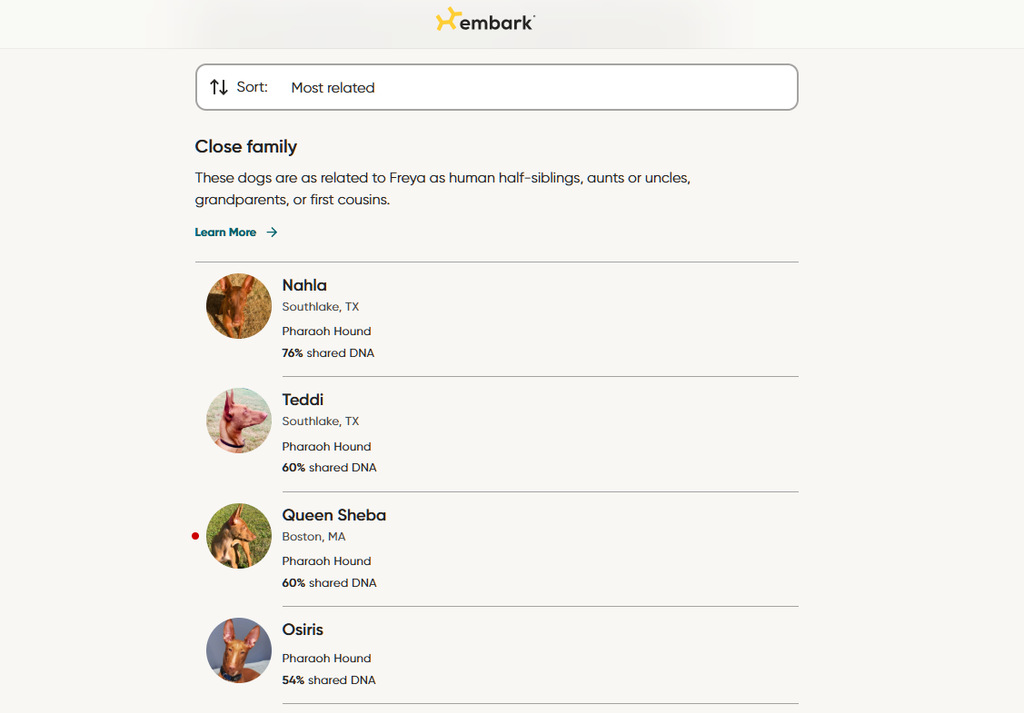
For purebred dogs like Freya, it’s an interesting way to explore lineage beyond what you already know.
For an adopted senior dog with an unknown background, though, I think this could be one of the most fascinating parts of the entire test.
Imagine adopting an eight-year-old mixed breed without knowing anything about their first few years, then discovering siblings or close relatives through DNA matching.
It doesn’t change the life you’ve built with your dog, obviously. But it can give you pieces of a history you thought you’d never know.
And sometimes it’s just fun. One of our team members, Emi, tested her mixed-breed dog Zola with Embark and actually found Zola’s siblings. She even got to take Zola to meet them.
That’s a pretty cool bonus from something you originally bought to find out what’s hiding in your dog’s DNA.
Is Embark Worth Buying for a Dog That’s Already 8, 10, or Even 12?
I think it can be. I wouldn’t skip DNA testing simply because your dog is already a senior.
If all you want is breed identification and you already know your dog’s breed, a less expensive breed-only test probably doesn’t make much sense.
The Breed & Health Kit is different because breed identification is only one part of what you’re getting.
For senior dogs, I’d consider Embark particularly worthwhile if:
- You adopted your dog later in life and know little about their background.
- You don’t know their breed or family history.
- You want genetic health information to add to their medical history.
- Your dog has unexplained health or sensitivity issues that you’re already discussing with your veterinarian.
- You’re curious about relatives or ancestry.
- You simply want a more complete picture of the dog you’ve spent all these years loving.
The older Freya gets, the less interested I am in novelty for novelty’s sake when it comes to pet products. I want things that either make her life easier, help me take better care of her, or give me information I can actually use.
Embark falls into that last category.
Final Verdict: My Embark Review for Senior Dogs
When I first tested Freya, I expected the breed portion to be the least exciting part, and I was right. Embark confirmed what I already knew: she’s 100% Pharaoh Hound.
The health results were a different story. Finding out that she was clear for all 273 genetic health risks included in her screening gave me information I didn’t have before.
There are plenty of fun extras. Finding relatives is genuinely entertaining, the trait information is interesting, and the personality results gave me several opportunities to say, “Yep, that’s Freya.”
But those aren’t the reason I’d recommend Embark specifically for an older dog.
I’d recommend it because senior dogs tend to come with increasingly thick mental (and sometimes literal) health files. We learn their patterns. We notice what’s changing. We pay more attention to things we probably didn’t think twice about when they were three.
DNA testing gives you one more piece of information to add to that picture. It can’t tell you exactly what the next few years will bring, and no responsible DNA test can.
But at nearly 10 years old, Freya still has plenty of surprises left in her. I’m perfectly happy knowing that 273 genetic health risks don’t appear to be among them.
The Embark Breed + Health DNA Test does more than tell you your dog’s breed mix—it screens for 270+ genetic health conditions and offers detailed insights into traits, ancestry, and even potential relatives. Results are clear, thorough, and backed by veterinary research. If you want more than a fun guess at your dog’s background (and actually useful health info), this test is one of the most comprehensive options out there.
LIMITED TIME OFFER
GET $60 OFF BREED + HEALTH TEST